𐄀 Focus on providing PCBA separator manufacturing process solution

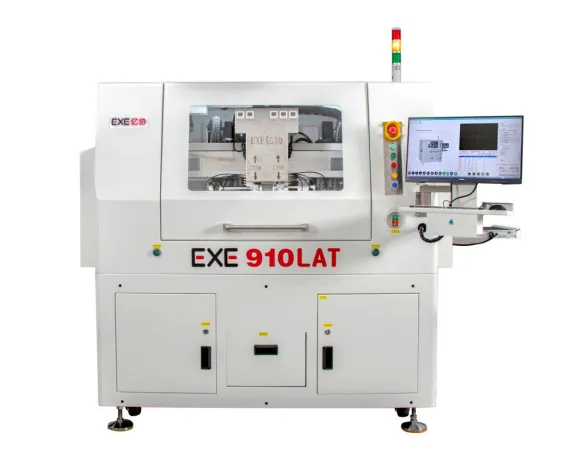
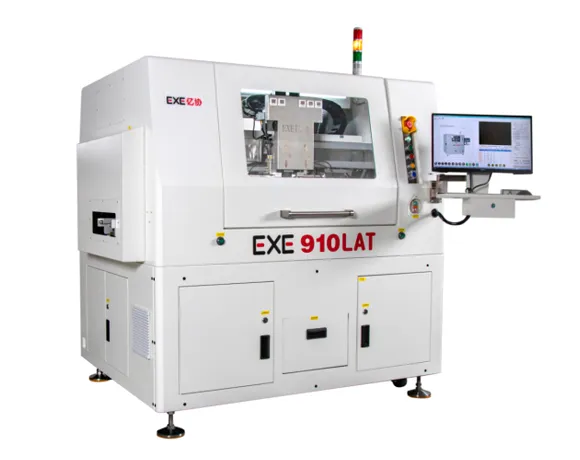
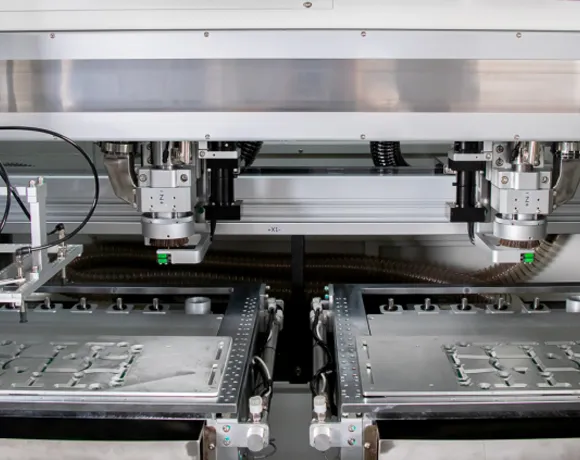
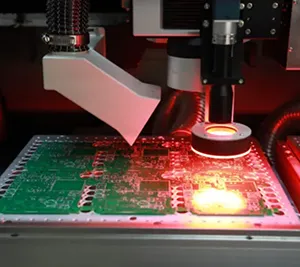
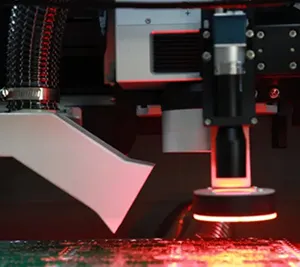
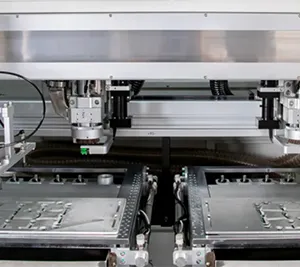
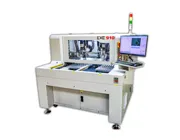
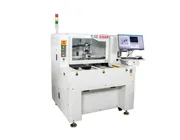
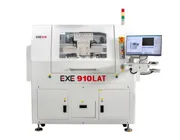
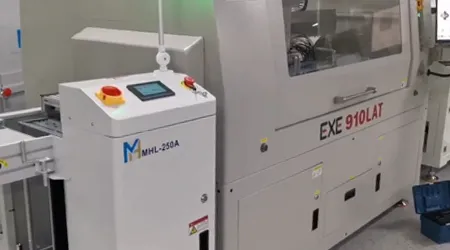
The EXE 910LAT Inline Dual-Spindle PCB Depaneling Machine is an automated PCB router system designed around two spindle processing areas and dual work platforms. Unlike a conventional single-spindle inline router, the dual-spindle architecture allows suitable PCB routing tasks to be processed across independent cutting areas within the automated production workflow.
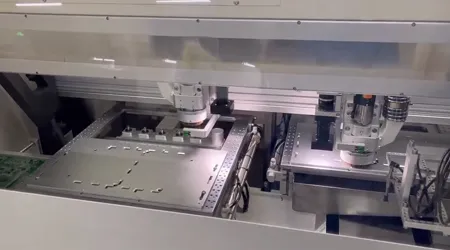
The system integrates rail feeding, vacuum pick-and-place transfer, CCD vision positioning, AC-servo motion and automatic tool changing. It is intended for production lines where routing workload, material handling and takt-time requirements justify a dual-spindle configuration.
The EXE 910LAT is an inline dual-spindle PCB depaneling machine built around two spindle processing areas, automated PCB handling, CCD positioning, and 9-axis servo motion. The specifications below describe the current machine configuration and should be evaluated together with the actual PCB panel, routing path, fixture, and required production cycle.
| Routing Performance | |
| Panel Separation Working Range | 300 × 350 mm |
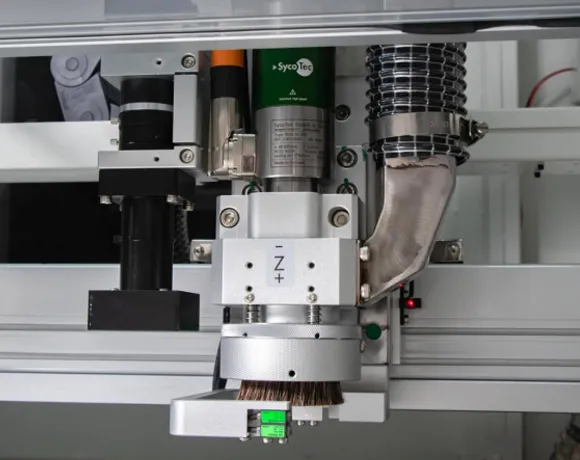
| Cutting Spindle | SycoTec (Germany), max. 80,000 rpm, automatic tool change |
| Tool Diameter | 0.8–3.0 mm |
| Cutting Accuracy | ±0.05 mm |
| X-Y Repeatability | ±0.02 mm |
| CCD Camera Calibration Accuracy | ±0.01 mm |
| X-Y AC Servo Speed | 0–1000 mm/s |
| Z-Axis AC Servo Speed | 0–800 mm/s |
| Motion, Vision & Control | |
| Number of Motion Axes | 9 Axes |
| XYZ Drive Method | AC Servo Motors |
| Drive Motor | AC Brushless Servo Motor |
| Programming Method | Color CCD Image-Based Intuitive Teaching Input |
| Vision System | High-Resolution Digital Camera |
| Control Method | Dedicated Controller |
| Operating Interface | Windows 7 Operating System Interface |
| Program Backup | USB Interface |
| Static Elimination | Static Elimination Gun |
| Inline PCB Handling | |
| Feeding Method | Rail Conveyor |
| Mechanical Pick-and-Place Arm | Anti-Static Vacuum Nozzle |
| Transfer Method | Vacuum Nozzle Suction Transfer |
| Discharging Method | Belt Conveyor, Carrier Output, or Rail Conveyor |
| Flow Direction | Left → Right; Right → Left Optional |
| Machine & Dust Collection | |
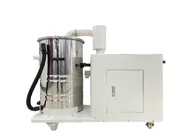
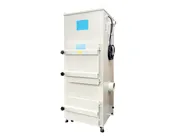
| Lower Dust Collector Power | 3 HP; Optional 5 HP |
| Main Unit & Dust Collector Voltage | 220 V, 1-Phase or 3-Phase |
| Power Consumption | 3.5 kVA |
| Dust Collection Cabinet Dimensions | 640 × 785 × 1760 mm (D × W × H) |
| Machine Dimensions | 1760 × 1290 × 1600 mm (D × W × H) |
| Main Unit + Dust Collector Weight | 1470 kg |
THE REASON FOR THE 910LAT
Why Use Two Spindles Instead of One?
A dual-spindle machine is most valuable when PCB routing itself becomes a meaningful part of the production-line cycle time. The EXE 910LAT uses two spindle processing areas and dual working platforms so suitable routing workloads can be organized across separate processing areas rather than relying on only one spindle.
This does not mean that every PCB will be produced twice as fast. Actual throughput also depends on routing length, cutting sequence, loading and unloading, fixture design, vision alignment, product transfer, and how effectively the routing workload can be distributed.
The EXE 910LAT should be understood as an automated routing system with two processing areas, not simply as a standard inline router with an additional spindle attached. The routing program, fixture, and production sequence determine how the two processing areas are used.
PCB Panel Enters Through Rail Conveyor
Vacuum Transfer + CCD Positioning
Processing Area A
Independent spindle processing area for the configured PCB routing workload.
Processing Area B
Second spindle processing area available according to the programmed production strategy.
Vacuum Transfer → Belt / Carrier / Rail Output
Important: The exact way routing tasks are divided between the two processing areas depends on the PCB, fixture, cutting program, and production configuration. A dual-spindle architecture should be validated against the real production cycle rather than evaluated from spindle count alone.
A common purchasing mistake is to compare only spindle speed. In an inline PCB depaneling system, the complete cycle contains several operations, and the slowest part of that sequence usually determines whether dual-spindle processing creates a meaningful production benefit.
ACTUAL DEPANELING CYCLE
Panel Transfer Time + Vision Alignment + Routing Time + PCB Handling + Product Output
If routing represents a large share of this total cycle and the cutting workload can be distributed effectively between processing areas, the EXE 910LAT is worth evaluating. If material transfer or another upstream/downstream process is already the bottleneck, adding spindle capacity alone may produce a smaller improvement.
Routing Is the Line Bottleneck
If one spindle cannot complete the required cutting workload within the target takt time, a dual-processing architecture may provide additional routing capacity.
The Panel Has a Significant Routing Workload
Long cutting paths, multiple PCBs per panel, or complex routing programs can make spindle utilization an important part of total cycle-time analysis.
The Production Line Requires Automated Material Flow
Rail feeding, vacuum transfer, and configurable output methods allow the depaneling operation to be integrated into an automated PCB production workflow.
Cycle-Time Validation Supports the Extra Processing Capacity
Dual-spindle equipment is most useful when actual production trials or cycle calculations show a measurable benefit over a single-spindle inline router.
When Is a Single-Spindle Inline Router Enough?
A dual-spindle machine is not automatically the better choice. A single-spindle inline router may already meet the production requirement when:
• Routing paths are relatively short and cutting is not the production bottleneck.
• The required takt time can already be achieved with one spindle.
• Product changeover flexibility is more important than additional parallel routing capacity.
• Another process limits line output, meaning additional spindle capacity would not materially change total production throughput.
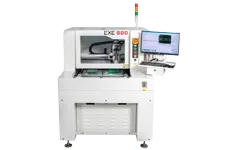
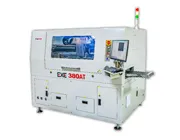
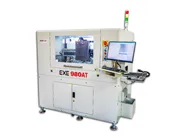
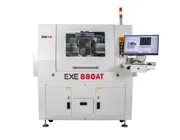
For a general-purpose single-spindle inline routing configuration, compare the EXE 880AT Inline PCB Depaneling Machine.
Both machines automate PCB feeding, routing, transfer, and output. The main purchasing question is whether the application requires the additional processing architecture of the EXE 910LAT.
| Decision Factor | EXE 910LAT | EXE 880AT |
|---|---|---|
| Production Mode | Inline | Inline |
| Spindle Architecture | Dual-spindle processing architecture | Single-spindle routing architecture |
| Motion Axes | 9 Axes | 7 Axes |
| PCB Feeding | Rail Conveyor | Rail Conveyor |
| PCB Transfer | Vacuum nozzle transfer | Vacuum handling |
| Automatic Tool Change | Yes | Yes |
| Main Selection Reason | Additional routing capacity where dual processing areas create a verified cycle-time benefit | General automated inline PCB routing where one spindle meets the takt-time requirement |
Dual Spindles & Dual Processing Areas
Two spindle processing areas provide the machine architecture required to distribute suitable PCB routing workloads according to the configured production program.
9-Axis Servo Motion
Nine motion axes and AC servo drives coordinate cutting, positioning, and automated PCB handling operations.
CCD Vision Alignment
High-resolution CCD imaging supports reference recognition and positioning, with published calibration accuracy of ±0.01 mm.
Automatic Tool Change
The SycoTec spindle configuration includes automatic tool-changing capability for automated router operation.
Vacuum Pick-and-Place Handling
Anti-static vacuum nozzles support PCB/PCBA pickup and transfer between the conveyor and configured processing positions.
Flexible Output Configuration
Belt conveyor, carrier output, or rail conveyor options allow the discharge method to be selected according to the production-line layout.
Router Tool Monitoring Matters More on an Automated Line
The EXE 910LAT includes functions for detecting abnormal cutter conditions such as tool breakage and tool slippage. In an automated production environment, tool-condition monitoring helps operators identify routing abnormalities without relying only on visual inspection after cutting.
Cutter diameter, spindle speed, feed rate, PCB material, and tool wear should still be evaluated as part of the actual routing process. For more information, see the PCB Router Bits for Depaneling Guide.
Dual-spindle processing does not automatically require conveyor integration. EXE also provides an offline dual-spindle configuration for manufacturers that require two processing areas but prefer a standalone production workflow.
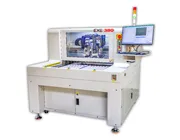
For standalone dual-spindle routing, review the EXE 910 Offline Dual-Spindle PCB Depaneling Machine. The EXE 910LAT should be selected when the application also requires inline feeding, automated PCB transfer, and production-line output.
The decision should be based on real cycle-time and PCB process data. Before specifying a dual-spindle line, prepare enough information to determine whether both processing areas can be used effectively.
If the PCB panel design is still being finalized, review the PCB Panelization Design for Automated Depaneling before fixture and routing-program development.
The dual-spindle architecture provides two processing areas so suitable PCB routing workloads can be distributed according to the production program. It is intended for applications where one spindle may become a routing-capacity bottleneck.
No. Total cycle time also includes feeding, PCB transfer, vision alignment, cutting-path length, fixture handling, and product output. The actual benefit of two spindles must be verified with the real PCB and production cycle.
Both are inline PCB router systems with automated material handling. The EXE 910LAT uses a dual-spindle, 9-axis processing architecture, while the EXE 880AT is a single-spindle inline router. Selection should be based on whether the application benefits from additional routing capacity.
Both belong to EXE's dual-spindle PCB router family. The EXE 910LAT adds inline rail feeding, automatic PCB transfer, and configurable production-line output, while the EXE 910 is intended for offline standalone dual-spindle processing.
The key question is not “Do I need two spindles?”
The better question is whether routing is limiting the required production cycle and whether the PCB workload can be divided effectively between two processing areas. This should be confirmed with actual PCB data and cycle-time evaluation before machine selection.
Is a Dual-Spindle Router Worth It for Your Production Line?
Send EXE your PCB panel drawing, cutting path, routing length, fixture requirements, target takt time, and expected production volume. We can evaluate whether the EXE 910LAT dual-spindle architecture offers a practical cycle-time benefit or whether a single-spindle inline router is sufficient.
Request a PCB Cycle-Time Evaluation