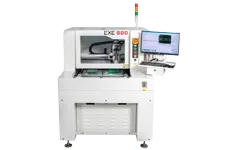
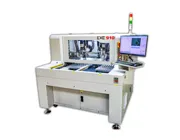
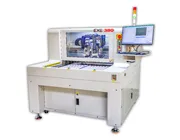
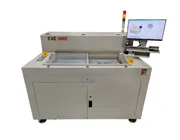
𐄀 Focus on providing PCBA separator manufacturing process solution

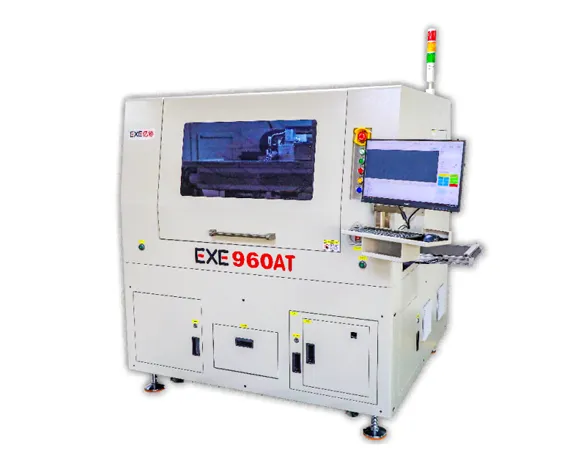
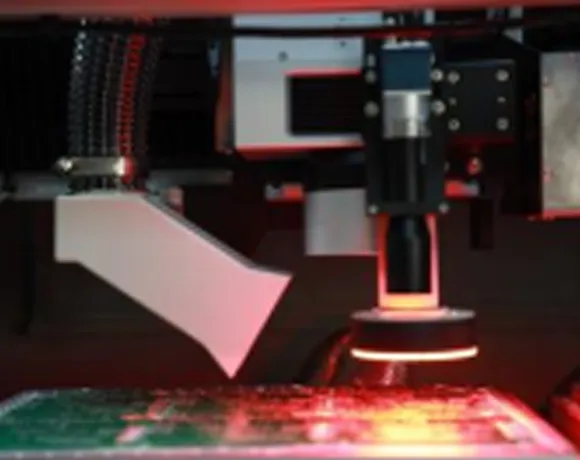
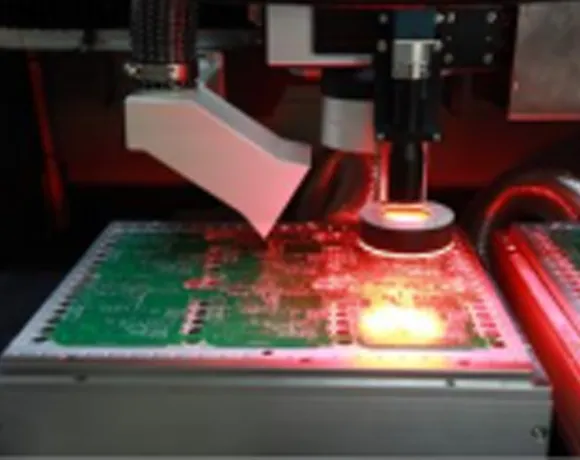
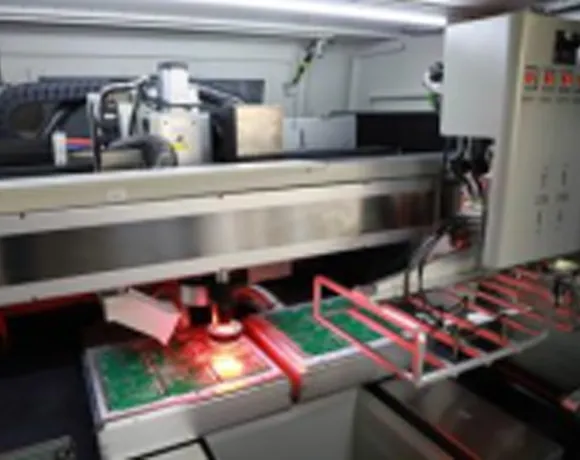
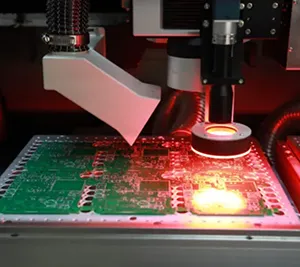
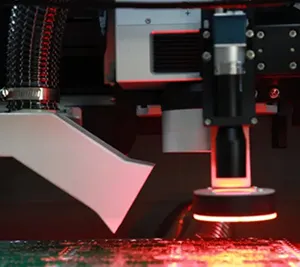
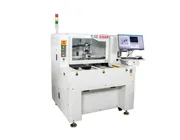
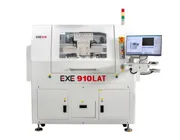
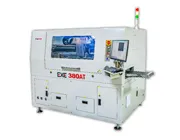
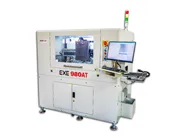
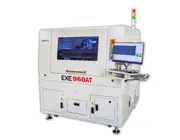
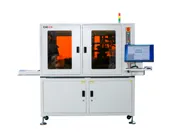
The EXE 960AT is an inline laser PCB depaneling machine designed to automate PCB/PCBA feeding, positioning, laser cutting, material transfer, and output within an integrated production workflow. Unlike mechanical router depaneling, the laser cutting process separates the PCB without direct router-bit cutting force.
The system combines CCD vision alignment, AC-servo motion, laser displacement sensing, and CNC motion control. With published cutting precision of ±25 μm and repeatability of ±2 μm, the EXE 960AT can be evaluated for automated electronics production where precision, non-contact separation, and inline material handling are important.
The following parameters are based on the current EXE 960AT technical data. Final configuration should be confirmed according to the PCB material, production requirements, laser process, and automation setup.
| Laser Cutting Performance | |
| Cutting Precision | ±25 μm |
| Repeatability | ±2 μm |
| Maximum Moving Speed | X/Y Axis: 1000 mm/s; Z Axis: 800 mm/s |
| Mirror Speed | ≥8000 mm/s |
| PCB Size | 300 × 350 (Customizable) |
| Machinable Material Thickness | ≤2 mm |
| Laser Power | 20 W (Optional) |
| X/Y/Z Resolution | 2 μm |
| Motion, Vision & Control | |
| XYZ Control Mode | CNC Motion Controller |
| XYZ Drive Method | AC Servo |
| Platform Structure | Marble Platform |
| CCD Light Source | Circular Light + Coaxial Light |
| Positioning & Compensation | CCD + Mark; Linear Compensation + Single-PCS |
| Cooling Method | Water-Cooled |
| Vision & Cutting Functions | |
| Mark Point Types | Standard Shape, Circular, Square |
| Cutting Functions | Straight Line, Semi-Circular Arc, Circular Arc, Left/Right Copy, Rotational Copy, Matrix Copy, Automatic Correction Compensation |
| Equipment & Utilities | |
| Equipment Power | AC 220 V ±10%, 50/60 Hz, 1.5 kW |
| Air Supply | 4–6 kg/cm² |
| Operating Humidity | 30%–60% |
| Machine Dimensions | 1400 × 1500 × 1600 mm |
| Machine Weight | 900 kg |
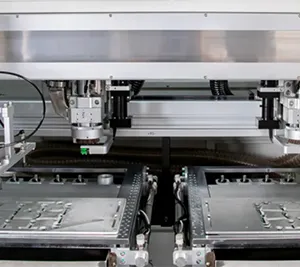
The main difference between the EXE 960AT and a standalone laser depaneling machine is not simply the laser source. The 960AT is designed around an inline automated material flow, allowing PCB handling and laser processing to operate as one production sequence.
01 — Automatic PCB Feeding
PCB or PCBA panels enter the depaneling system as part of the automated production workflow.
02 — Product Transfer & Positioning
The product is transferred into the processing position, where the motion system prepares the PCB for vision alignment and laser cutting.
03 — CCD Vision Alignment
CCD and Mark recognition are used to identify PCB reference positions and support coordinate correction before processing.
04 — Programmable Laser Depaneling
The system executes the programmed laser cutting path, including straight lines, circular arcs, semi-circular arcs, copy functions, and automatic correction compensation.
05 — Automatic Product Output
After laser processing, the separated product moves to the output stage for connection with the next manufacturing operation according to the configured production line.
Inline laser depaneling is not automatically the best solution for every PCB. Its value becomes clearer when non-contact separation and automated production-line handling are both important to the manufacturing process.
Non-Contact Cutting
Laser processing does not require a mechanical router bit to contact the PCB, avoiding direct milling-cutter force during the cutting operation.
No Router-Bit Tool Change
Because material is removed by laser rather than a milling cutter, the process does not depend on router-bit wear or periodic router-bit replacement.
Programmable Cutting Geometry
Straight lines, arcs, copy functions, and compensation functions support a range of programmed PCB cutting paths.
Inline Material Flow
Automated feeding, positioning, cutting, transfer, and output reduce dependence on separate manual loading between processing steps.
CCD Vision Positioning
Circular and coaxial lighting support Mark recognition and PCB reference positioning before laser processing.
CNC Motion Control
A dedicated CNC motion controller coordinates the programmed XYZ movement required during the laser depaneling process.
AC Servo Drive System
AC servo drives provide controlled motion across the machine's positioning axes.
Marble Platform Structure
The marble platform provides a stable structural foundation for precision motion and laser processing.
Programmable Pattern Processing
Cutting functions include straight lines, semi-circular arcs, circular arcs, left/right copy, rotational copy, matrix copy, and automatic correction compensation.
Automated Production Workflow
The system is designed to combine PCB feeding, positioning, laser processing, and output within an inline production configuration.
Both systems use laser processing, but they address different production environments. The key distinction is automation mode, not simply which machine has the higher specification value.
| Comparison | EXE 960AT | EXE 960 |
|---|---|---|
| Production Mode | Inline automated production | Offline standalone production |
| Material Feeding | Automated workflow | Operator-assisted offline workflow |
| Cutting Process | Programmable laser cutting | Programmable laser cutting |
| Product Output | Integrated automated output | Offline handling workflow |
| Best Evaluated For | Automated lines requiring laser depaneling and continuous material handling | Flexible standalone laser processing and offline product changeovers |
If production-line integration is not required, review the EXE 960 Offline Laser PCB Depaneling Machine for a standalone laser depaneling configuration.
Laser depaneling should be evaluated from the actual PCB and production process. A non-contact cutting method does not mean every material, board thickness, or production requirement will produce the same result.
Not sure whether laser or router depaneling is more appropriate? Compare the main differences in cutting principle, mechanical stress, geometry, dust, and application requirements in our PCB Depaneling Methods Comparison.
The EXE 960AT can be evaluated for electronics manufacturing applications where automated production and non-contact laser separation are both important. Final suitability depends on the actual PCB material and process requirements.
Precision Electronics
Compact PCB layouts, programmed contours, and production processes where controlled laser positioning and automation are required.
Medical Electronics
Laser depaneling may be evaluated for medical electronic assemblies where non-contact processing, precision, and controlled manufacturing are important. View medical PCB depaneling solutions.
Communication Electronics
Communication, network, RF, and related electronic assemblies may require precise routing geometry and automated processing. View communication PCB depaneling solutions.
Compact & High-Density Electronics
Small-format or densely integrated electronics can be evaluated where narrow processing areas, programmable cutting paths, or automated material handling are required.
Need an Inline Router Instead of Laser?
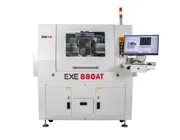
For automated PCB routing with a mechanical spindle, automatic tool change, and inline PCB handling, review the EXE 880AT Inline PCB Depaneling Machine.
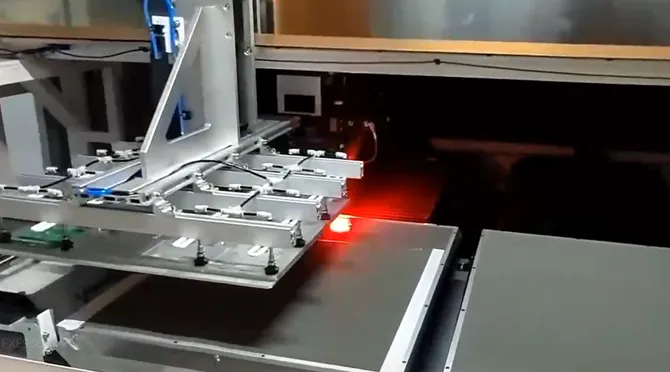
Watch the EXE 960AT production workflow to see automated PCB handling and laser processing in operation. Actual handling configuration and production-line integration may vary according to the PCB and customer application.
An inline laser PCB depaneling machine combines automated PCB handling with non-contact laser cutting in a production-line workflow. Instead of manually transferring each panel to a standalone workstation, feeding, positioning, cutting, and output can be integrated into an automated process.
The EXE 960AT is designed for inline automated laser depaneling, while the EXE 960 is an offline laser depaneling platform. The choice depends mainly on production-line integration, material-handling requirements, product mix, and manufacturing workflow.
The published cutting precision is ±25 μm, with repeatability of ±2 μm and X/Y/Z resolution of 2 μm.
No. Laser depaneling removes PCB material using laser energy rather than a mechanical milling cutter, so there is no router-bit wear or router-bit replacement during the laser cutting process.
Useful evaluation information includes PCB material, PCB and panel dimensions, material thickness, cutting drawing or path, component clearance, required cutting quality, production cycle time, expected volume, and production-line automation requirements.
EXE 960AT is an automation choice, not simply a “higher version” of EXE 960
Choose between the two systems according to the real production workflow. The EXE 960 is intended for flexible offline laser processing, while the EXE 960AT focuses on combining laser depaneling with automated PCB feeding, transfer, and output. PCB material compatibility and final cutting quality should be validated before either process is confirmed.
Is the EXE 960AT Suitable for Your PCB Production Line?
Send EXE your PCB material, panel size, thickness, cutting drawing, required edge quality, component-clearance information, cycle-time target, and automation requirements. Our team can evaluate whether an inline laser or alternative PCB depaneling process is more appropriate for your application.
Request a Laser Depaneling Evaluation