𐄀 Focus on providing PCBA separator manufacturing process solution

Automotive PCB Depaneling at a Glance
Automotive electronics such as ECUs, ADAS control modules, battery management systems (BMS), EV power electronics, infotainment systems, and vehicle lighting controllers often use densely populated PCB assemblies that require accurate and repeatable separation after assembly.
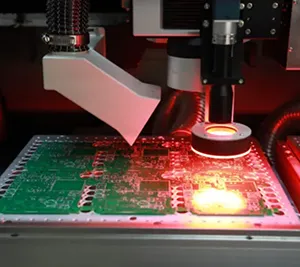
EXE provides PCB depaneling solutions for automotive electronics using router and laser technologies. Depending on PCB structure, material, component clearance, production volume, cycle-time target, and automation requirements, manufacturers can evaluate offline or inline equipment for precise and controlled PCB separation.
Automotive PCB depaneling is not simply a matter of separating boards from a panel. PCB geometry, component layout, mechanical stress, cutting debris, product changeovers, and production-line requirements all influence the final process.
1. High-Density Components and Limited Edge Clearance
Automotive control boards may contain connectors, sensors, ceramic components, BGAs, power devices, and other components located close to the PCB edge. The cutting path and fixture therefore need to provide sufficient clearance while maintaining accurate board positioning.
2. Mechanical Stress During PCB Separation
Excessive board flex or separation force may increase manufacturing risk around mechanically sensitive components and solder joints. Stable PCB support, appropriate cutting parameters, controlled routing paths, and suitable depaneling technology are therefore important process considerations.
3. Cutting Accuracy and Dimensional Consistency
Automotive PCBs are frequently assembled into defined housings, connectors, mechanical frames, or modules. Repeatable board dimensions and stable cutting paths help maintain consistency between the PCB separation process and downstream assembly requirements.
4. Routing Dust and Process Cleanliness
Mechanical PCB routing generates FR4, resin, fiberglass, and other cutting debris. Effective local extraction and appropriate dust collection help reduce contamination around PCB assemblies, fixtures, cutting tools, and machine components.
5. High-Mix and Automated Production
Automotive electronics manufacturers may need to process multiple PCB models or integrate depaneling into automated production lines. Program management, rapid product changeover, automated material handling, vision alignment, and process monitoring can therefore be important when selecting equipment.
There is no single cutting-accuracy or stress specification that applies to every automotive PCB. Equipment requirements should be defined according to the actual PCB, component layout, panel design, quality requirements, and production process.
| Requirement | Why It Matters |
|---|---|
| Controlled Mechanical Stress | Helps reduce PCB flex and mechanical force transferred toward sensitive components and solder joints. |
| Accurate Cutting Path | Important for dense PCB layouts, irregular contours, component clearance, and dimensional consistency. |
| Stable PCB Fixturing | Helps prevent PCB movement and vibration while supporting the board throughout the cutting sequence. |
| CCD Vision Alignment | Helps identify reference points and compensate for panel-position variation before cutting. |
| Tool and Process Monitoring | Supports repeatable production by helping operators control cutter condition, machine status, and process parameters. |
| Dust Extraction | Removes routing debris from the cutting area and helps maintain a cleaner machine and fixture environment. |
| Flexible Changeover | Useful when several ECU, ADAS, BMS, or other automotive PCB models share the same production environment. |
| Automation and Traceability | Automated handling, program control, identification, and data interfaces may be required for high-volume automotive production. |
PCB depaneling requirements vary significantly across automotive electronic systems. The following applications illustrate where controlled router or laser separation may be evaluated.
| Automotive Application | Typical PCB Assemblies |
|---|---|
| ECU | Engine, body, chassis, gateway, and other electronic control module PCBs |
| ADAS | Camera, radar, sensor, and advanced driver-assistance control boards |
| Battery Management Systems | BMS control, battery monitoring, communication, and management PCBs |
| EV Power Electronics | Inverter, onboard charger, DC-DC converter, and power-control PCBs |
| Infotainment & Connectivity | Displays, telematics, connectivity gateways, multimedia, and communication electronics |
| Vehicle Lighting Electronics | LED driver, headlamp, interior-lighting, and lighting-control boards |
Router and laser depaneling can both support automotive electronics, but they solve different manufacturing requirements. The decision should be based on the PCB material, thickness, geometry, component clearance, mechanical-stress requirement, cycle time, and production cost.
| Factor | Router Depaneling | Laser Depaneling |
|---|---|---|
| Cutting Method | Mechanical milling | Non-contact laser processing |
| Mechanical Cutting Force | Low when the fixture, cutter, and routing process are properly controlled | Very low because no mechanical cutting tool contacts the PCB |
| Complex Contours | Excellent where sufficient router-bit access is available | Excellent programmable cutting flexibility |
| Cutting Tool | Router bit is a consumable | No mechanical router bit |
| Typical Selection | Broad rigid-PCB applications, high-mix production, and automated routing | Precision or mechanically sensitive applications requiring non-contact separation |
Selection Note: Neither router nor laser depaneling is universally better. Automotive manufacturers should validate the process using the actual PCB material, panel design, component layout, cutting path, quality requirement, and production target.
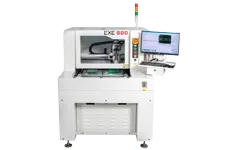
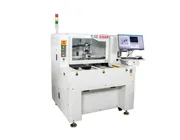
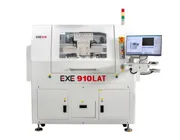
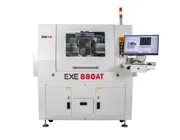
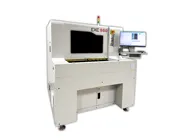
Designed for flexible offline router depaneling, the EXE 880 is suitable for manufacturers processing multiple PCB types or requiring standalone production. The published specification includes ±0.05 mm cutting accuracy, ±0.02 mm X-Y repeatability, CCD vision positioning, and board separation stress below 300 µε.
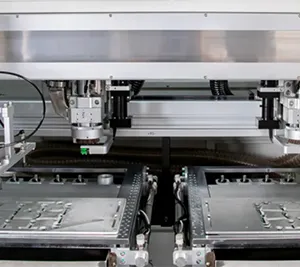
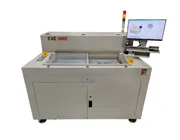
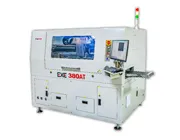
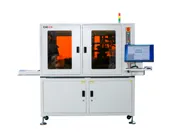
The EXE 880AT is designed for inline PCB depaneling with automated board feeding, cutting, and discharge. It combines CCD vision positioning, automatic material handling, CNC motion control, dust extraction, and automatic router-bit changing for production lines that require a higher level of automation.
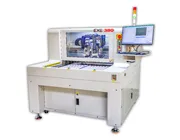
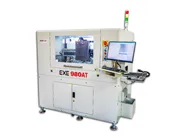
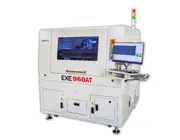
For automotive PCB applications where non-contact processing, especially low mechanical cutting force, or precision cutting is a priority, the EXE 960 provides an offline laser alternative. Its published specifications include ±20 μm cutting precision and ±2 μm repeatability.
Automotive electronics manufacturers may operate under quality systems that require controlled manufacturing parameters, documented process changes, defined operator permissions, and production traceability. The depaneling process should therefore be considered as part of the overall manufacturing-control system rather than as an isolated cutting operation.
Depending on the machine configuration and project requirements, useful functions may include recipe and program management, user permissions, vision-based positioning, cutter monitoring, automatic tool changing, production counting, identification, alarm records, and interfaces with factory systems.
Integration Tip: If barcode tracking, MES communication, specific data records, or customer-defined traceability functions are required, confirm the interface and software requirements during equipment evaluation rather than assuming that every machine configuration includes them as standard.
Before selecting an automotive PCB depaneling machine, prepare the actual PCB and production information rather than comparing equipment only by maximum speed or cutting accuracy.
PCB material and board thickness
Individual PCB and complete panel dimensions
Panel drawing and required cutting path
Component positions and edge clearance
Required cutting accuracy and edge quality
Mechanical-stress requirements
Daily production volume and target cycle time
High-mix versus high-volume production requirements
Offline or inline manufacturing layout
Automation, traceability, barcode, or factory-system integration requirements
PCB panel design also affects automated separation. Router channels, breakaway tabs, fiducials, tooling holes, component clearance, and fixture-support areas should be reviewed before the production panel is finalized.
Related Technical Guide: Learn how machine stability, spindle performance, CCD alignment, tooling condition, PCB support, and dust extraction affect routing quality in How Does a PCB Depaneling Machine Achieve Clean and Precise Cuts?
Router depaneling is suitable for many rigid automotive PCBs that require flexible cutting paths and efficient production. Laser depaneling can be considered when non-contact processing, especially low mechanical cutting force, narrow cutting paths, or high precision are important. The final method should be validated using the actual PCB.
ECU and ADAS boards may contain mechanically sensitive components, solder joints, connectors, and dense component layouts. Controlling PCB flex and separation force helps reduce unnecessary mechanical loading during the final board-separation process.
Yes. Router depaneling can be suitable for many rigid automotive PCB assemblies, including irregular board shapes and high-mix production. Cutting results depend on router-bit condition, spindle performance, fixture stability, cutting parameters, path design, and effective dust extraction.
Laser depaneling is worth evaluating when the application benefits from non-contact cutting, very low mechanical cutting force, precision separation, or complex programmed cutting paths. PCB material, thickness, thermal effects, extraction requirements, and cycle time should also be evaluated.
Offline machines operate as standalone workstations and can be useful for flexible or high-mix production. Inline depaneling systems integrate automatic PCB handling with the production line and are better suited to applications requiring continuous automated material flow and higher production automation.
Useful information includes PCB material, thickness, board and panel dimensions, panel drawing, cutting path, component clearance, required edge quality, production volume, cycle-time target, preferred offline or inline workflow, and any traceability or automation requirements.
Evaluate a PCB Depaneling Solution for Your Automotive Project
Send EXE your PCB material, thickness, panel drawing, cutting path, component clearance, production volume, cycle-time target, and automation requirements. Our team can help evaluate router, laser, offline, or inline PCB depaneling options for your automotive electronics application.
Request an Automotive PCB Evaluation