𐄀 Focus on providing PCBA separator manufacturing process solution

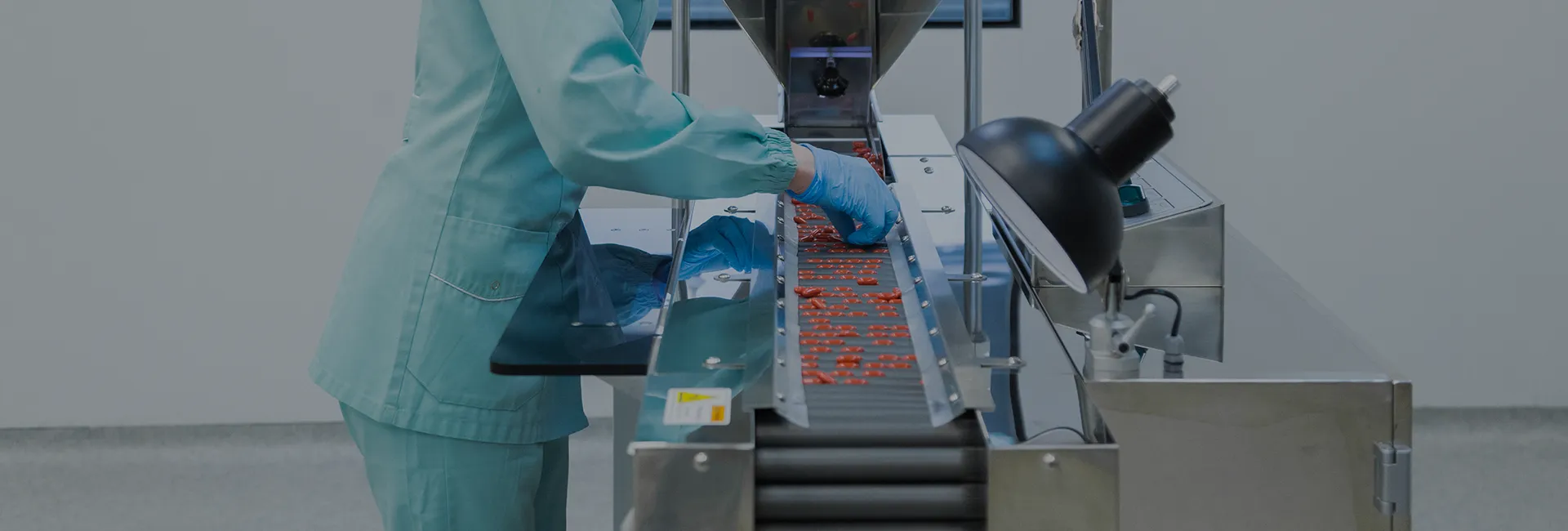
Medical PCB Depaneling at a Glance
Medical electronic assemblies often use compact PCB layouts, high-density components, sensitive solder joints, and tightly controlled mechanical structures. During depaneling, excessive cutting force, vibration, dust, or positioning errors may introduce board stress, edge defects, or damage near sensitive components.
A suitable PCB depaneling machine for medical electronics should therefore focus on low-stress separation, accurate vision alignment, stable motion control, effective dust extraction, repeatable process parameters, and flexible production. Router and laser depaneling can both be used depending on PCB material, thickness, component layout, production volume, and cleanliness requirements.
PCB depaneling is one of the final manufacturing processes before individual medical electronic PCB assemblies move to testing, inspection, enclosure assembly, and final product integration. Although it occurs late in the PCBA process, an unstable separation process can affect work completed during earlier SMT and assembly stages.
For this reason, medical electronics manufacturers should evaluate not only cutting speed, but also board stress, positioning accuracy, fixture stability, tool condition, dust control, repeatability, and production traceability when selecting a PCB depaneling machine.
Medical electronic products can vary significantly in function and PCB structure, but many applications share demanding requirements for manufacturing consistency, reliability, compact design, and process control. These characteristics make PCB separation more than a simple cutting operation.
1. High-Density Components and Limited Edge Clearance
Medical control boards, sensor modules, portable diagnostic devices, and monitoring electronics may use compact layouts with BGA, CSP, fine-pitch components, connectors, sensors, or other components positioned close to the PCB edge. The smaller the distance between the routing path and nearby components, the more important cutting-path accuracy and fixture stability become.
2. Mechanical Stress During PCB Separation
Excessive board bending or cutting force can transfer stress into solder joints, ceramic components, connectors, and other mechanically sensitive areas. Controlled router depaneling can reduce cutting stress through stable workholding, appropriate routing parameters, sharp cutting tools, and optimized cutting paths. For especially stress-sensitive applications, non-contact laser cutting may also be considered.
3. Cutting Accuracy and Repeatability
Compact enclosures, irregular PCB shapes, narrow board edges, and components positioned close to the cutting path can make dimensional control important. Machine rigidity, servo motion, CCD vision positioning, fixture repeatability, and correct calibration all contribute to consistent PCB separation.
4. Dust and Product Cleanliness
Router depaneling generates particles from materials such as FR4, resin, and fiberglass. Effective dust extraction helps prevent debris from accumulating on the PCB, fixture, vision system, or machine components. Dust-control requirements should therefore be evaluated together with the cutting method.
5. High-Mix Production and Process Control
Medical electronics manufacturing may involve multiple PCB models, product revisions, or different production volumes. Program management, fast fixture changeover, vision-based position correction, user permissions, tool-life management, and production data interfaces can help manufacturers maintain repeatable processes across different products.
When evaluating PCB depaneling equipment for medical electronics, process engineers should consider the complete manufacturing process rather than focusing on a single specification.
| Requirement | Why It Matters for Medical Electronics |
|---|---|
| Low Mechanical Stress | Helps reduce board flex and mechanical force transferred to solder joints and sensitive components. |
| Cutting Accuracy | Important for compact PCB layouts, irregular contours, and components positioned near the board edge. |
| CCD Vision Alignment | Helps compensate for loading offsets, panel variation, and fixture tolerances before cutting. |
| Stable PCB Fixturing | Reduces PCB movement and vibration during routing, supporting more repeatable cutting results. |
| Dust Extraction | Removes FR4 and routing debris from the cutting area and helps maintain product and machine cleanliness. |
| Process Repeatability | Supports consistent manufacturing results across repeated production batches. |
| Controlled Process Settings | User permissions, recipe management, tool monitoring, and parameter control help reduce unintended process changes. |
| Flexible Changeover | Useful for manufacturers processing multiple PCB models or high-mix, lower-volume production. |
During high-speed routing, the machine structure, worktable, fixture, linear guides, ball screws, and servo motion system work together to control cutter position. A rigid platform helps minimize vibration and provides a more stable reference for the programmed cutting path.
PCB panels may have small loading offsets or dimensional variation. A vision system identifies fiducial or Mark points, determines the actual PCB position, compares it with the programmed cutting path, and applies coordinate compensation before cutting. This is particularly useful when component clearance near the routing path is limited.
Router bits gradually wear during production. Tool wear may increase cutting force and contribute to burrs, rough PCB edges, dimensional variation, or tool breakage. Cutter monitoring, tool-life management, and cutting-depth compensation can therefore play an important role in maintaining repeatable routing performance.
PCB routing produces FR4, fiberglass, and resin particles. Depending on the application and fixture design, manufacturers can use upper dust collection or lower dust collection to remove debris close to the cutting area.
Technical Guide: For a detailed explanation of machine stability, spindle performance, CCD alignment, router-bit condition, and cutting quality, read How Does a PCB Depaneling Machine Achieve Clean and Precise Cuts?
Router and laser depaneling can both be used for medical electronics, but the two technologies solve different manufacturing requirements. The appropriate method should be selected according to PCB material, thickness, cutting path, component sensitivity, production volume, cleanliness requirements, and acceptable mechanical stress.
| Factor | Router PCB Depaneling | Laser PCB Depaneling |
|---|---|---|
| Cutting Method | Mechanical material removal using a rotating milling cutter. | Non-contact cutting using laser energy. |
| Mechanical Stress | Low when fixture design, cutter condition, routing parameters, and cutting sequence are correctly controlled. | Very low because there is no mechanical milling cutter contacting the PCB. |
| Cutting Debris | Generates routing dust and requires effective dust extraction. | Does not generate router-bit dust, although laser fumes and particles still require suitable extraction. |
| Tool Wear | Router bits are consumable tools and require tool-life management. | No mechanical router bit is used. |
| PCB Thickness | Suitable for a broad range of rigid PCB thicknesses depending on machine and tool configuration. | Suitability depends on PCB material, thickness, laser source, and process requirements. |
| Complex Contours | Suitable for straight and irregular routing paths where tool access is available. | Suitable for complex and high-precision cutting paths. |
| Typical Selection | Conventional rigid PCB assemblies, flexible product changeovers, wider board thickness requirements, and general PCBA production. | Applications where non-contact cutting, very low mechanical stress, narrow cutting paths, thin materials, or high precision are priorities. |
Important: Laser depaneling is not automatically better than router depaneling for every medical PCB. The correct process should be selected from the actual PCB structure, material, thickness, cutting path, allowable stress, cleanliness requirement, takt time, and production cost.
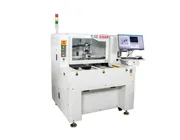
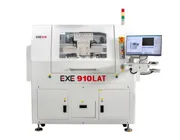
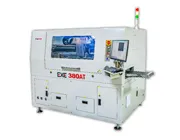
EXE provides router and laser PCB depaneling platforms that can be evaluated according to different medical electronics production requirements. The following two machines illustrate the differences between mechanical routing and non-contact laser cutting.
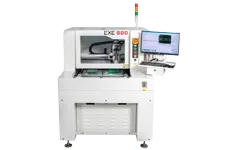
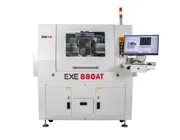
The EXE 880 Offline PCB Depaneling Machine uses high-speed mechanical routing and CCD vision positioning. It can be considered for rigid PCB assemblies requiring flexible routing paths, product changeovers, controlled mechanical separation, and offline production.
| X-Y Repeat Accuracy | ±0.02 mm |
| Cutting Accuracy | ±0.05 mm |
| CCD Calibration Accuracy | ±0.01 mm |
| Board Separation Stress | Below 300 μɛ |
| NSK Spindle Speed | Max. 60,000 rpm |
| PCB Cutting Thickness | 0.2–6.0 mm |
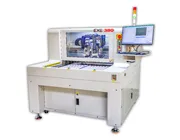
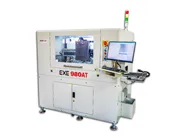
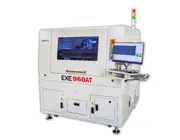
The EXE 960 Offline Laser Depaneling Machine uses a non-contact laser process. It can be evaluated for medical electronic PCB applications where very low mechanical stress, precision cutting, narrow paths, or material-specific laser processing are important.
| Cutting Precision | ±20 μm |
| Repeatability | ±2 μm |
| X/Y/Z Resolution | 1 μm |
| Cutting Method | Non-contact laser processing |
Medical electronics cover a wide range of products and PCB structures. The following examples illustrate applications where accurate and repeatable PCB separation may be required.
Patient Monitoring Electronics
PCB assemblies used in monitoring systems, portable monitors, sensor interfaces, and related control modules may combine compact layouts with sensitive components and connectors.
Diagnostic Equipment
Laboratory analyzers, portable diagnostic systems, testing modules, and electronic control boards may require repeatable cutting dimensions and stable separation processes.
Medical Imaging Electronics
Imaging systems may contain control boards, signal-processing boards, sensor modules, and other PCB assemblies where component density and dimensional consistency are important.
Wearable and Portable Healthcare Electronics
Compact wearable or portable healthcare electronics may use small PCBs, thin materials, dense layouts, or irregular contours that require precise cutting-path control.
Surgical and Treatment Equipment Electronics
Control boards and electronic modules used inside treatment or surgical equipment may require stable manufacturing processes and carefully controlled PCB separation.
The best depaneling solution cannot be selected from machine specifications alone. EXE recommends reviewing the actual PCB, production requirements, and quality targets before deciding between router, laser, offline, or inline equipment.
Information to Prepare Before Machine Selection
PCB material, such as FR4, aluminum, ceramic, flex, or rigid-flex
PCB and panel dimensions
PCB thickness
Panel drawing or Gerber/DXF cutting-path information
Minimum component clearance from the cutting edge
Mechanical-stress or cutting-quality requirements
Required cycle time and daily production volume
Dust-control and product-cleanliness requirements
Offline or inline automation requirement
MES, traceability, barcode, or factory-integration requirements
For high-mix production, fixture flexibility, program recall, vision alignment, and fast changeover may be priorities. For high-volume production, automation, loading and unloading efficiency, production-line integration, repeatability, and traceability may become more important.
Medical-device and medical-electronics manufacturers may operate under controlled quality-management systems that require repeatable manufacturing processes, documented settings, controlled changes, and appropriate production records.
In PCB depaneling, useful process-control functions may include recipe management, user-access permissions, tool-life monitoring, alarm records, parameter storage, barcode identification, production counters, and MES integration where required by the customer's manufacturing system.
Compliance Note: A PCB depaneling machine alone does not determine whether a medical-device manufacturing process complies with a particular quality standard. Equipment capabilities should be evaluated as part of the manufacturer's complete validated production and quality-control system.
There is no single best method for every medical PCB. Router depaneling is suitable for many rigid PCB assemblies and offers flexible mechanical routing, while laser depaneling can be advantageous for applications requiring non-contact cutting, very low mechanical stress, narrow cutting paths, or high precision. Selection should be based on the actual PCB and production requirements.
Excessive board bending or cutting force can transfer mechanical stress to solder joints, ceramic components, connectors, and other sensitive areas. Stable fixturing, appropriate routing parameters, sharp tools, optimized cutting paths, and suitable depaneling technology help reduce this stress.
Yes. Router depaneling can be suitable for many rigid medical PCB assemblies when board support, cutter condition, spindle speed, feed rate, cutting sequence, and dust extraction are correctly controlled. The actual PCB should be evaluated before confirming the process.
Laser depaneling may be considered when non-contact processing, very low mechanical stress, high positioning precision, narrow cutting paths, thin materials, or complex contours are important. Material compatibility, heat-affected characteristics, cycle time, and extraction requirements should also be evaluated.
Dust can be controlled by extracting routing debris close to the cutting point using upper or lower dust-collection systems. Extraction airflow, suction position, filter condition, fixture design, enclosure sealing, and maintenance all influence dust-removal performance.
Useful information includes PCB material, thickness, panel dimensions, cutting drawing, component clearance, expected production volume, required cycle time, stress requirements, dust-control requirements, and whether the process should be offline or integrated into an automated production line.
PCB depaneling for medical electronics requires more than fast board separation. Cutting accuracy, mechanical stress, fixture stability, vision alignment, tool condition, dust extraction, process repeatability, and production requirements should all be evaluated together.
Router depaneling provides a flexible solution for many rigid PCB assemblies, while laser depaneling offers a non-contact alternative for applications requiring especially low mechanical stress or high precision. The correct technology depends on the actual PCB structure, material, component layout, cleanliness requirements, cycle time, and production environment.
EXE provides offline, inline, router, and laser PCB depaneling solutions that can be configured according to different medical electronics manufacturing requirements.
Discuss Your Medical PCB Depaneling Application
Send EXE your PCB material, thickness, panel drawing, component-clearance requirement, production volume, and expected cycle time. Our team can help evaluate whether router or laser depaneling is more suitable for your application.
Request a PCB Depaneling Evaluation