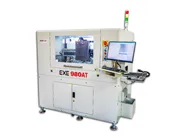
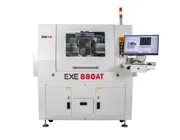
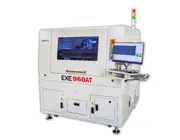
𐄀 Focus on providing PCBA separator manufacturing process solution

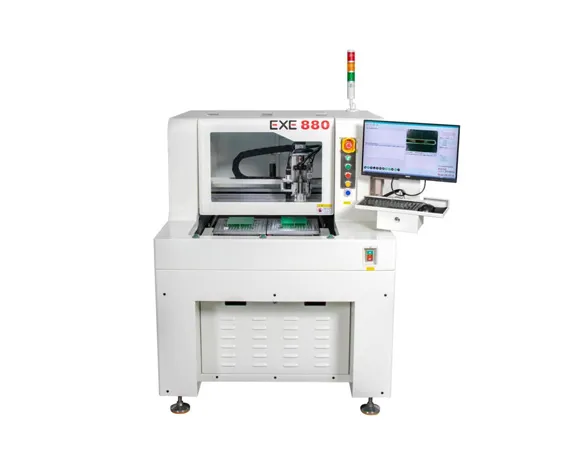
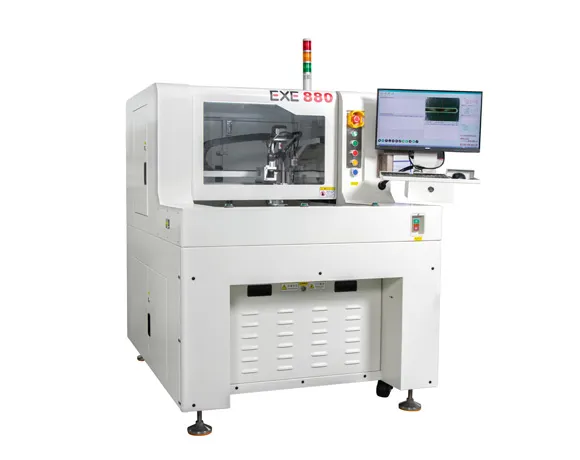
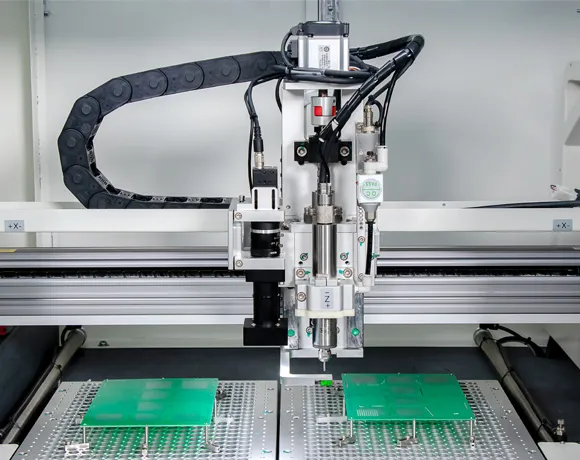
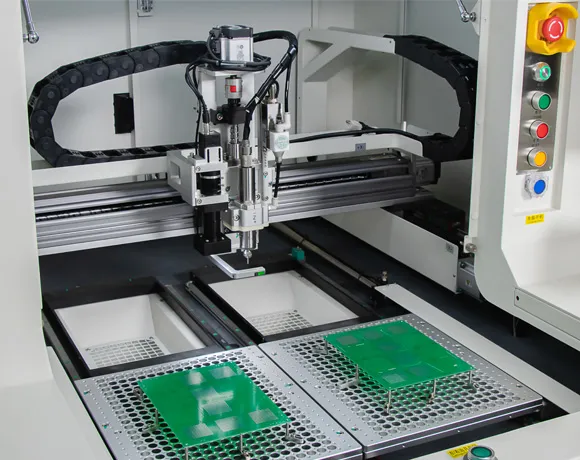
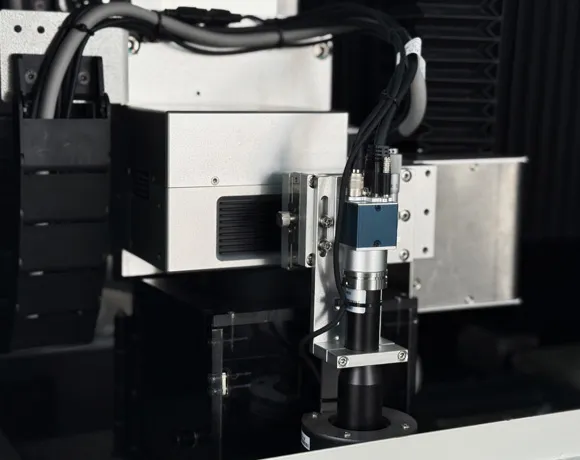
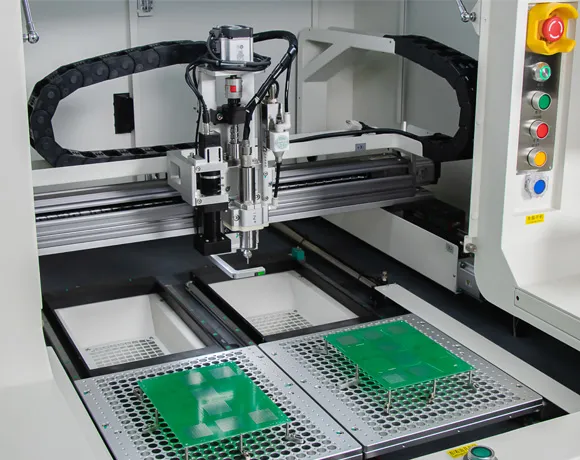
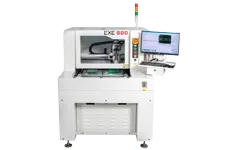
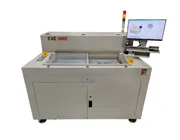
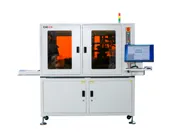
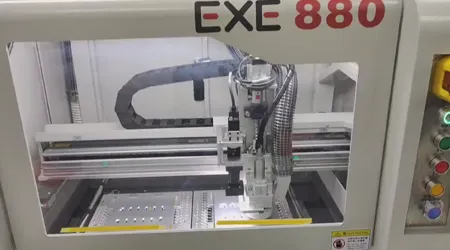
The EXE 880 Offline PCB Depaneling Machine is designed for precise, low-stress separation of PCB and PCBA panels using high-speed router cutting. Equipped with CCD vision alignment and a flexible dual-worktable design, it supports accurate positioning, stable routing, and efficient product changeovers. The EXE 880 is ideal for high-mix PCB production, irregular board shapes, and applications where cutting accuracy, low mechanical stress, and production flexibility are important.
Single-sided working dimensions | 300mm X 350mm |
Dual workbenches with simultaneous entry and exit | 580mm X 350mm |
X-Y AC Servo speed | 0-1000mm/sec |
Z AC Servo speed | 0-800mm/sec |
X-Y repeat accuracy | ±0.02mm |
Cutting accuracy | ±0.05mm |
CCD camera calibration accuracy | ±0.01mm |
Board separation stress | Below 300uε |
NSK spindle speed | Max. 60,000rpm |
Tool diameter | 0.8-3.0mm |
PCB cutting thickness | 0.2mm-6.0mm |
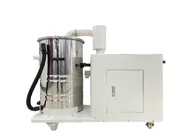
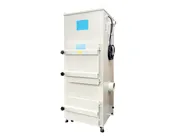
Dust collector power | 3HP (Option: 5HP) |
Dust collection cabinet dimensions | 640mm×785mm×1760mm (D×W×H) |
| Machine dimensions | 1075mm×1430mm×1460mm (D×W×H) |
| Weight of main unit + dust collector | 800 KG |
| Factor | EXE 880 Offline | Inline PCB Depaneling |
| Loading | Operator-assisted | Automatic |
| Production mode | Standalone | Integrated line |
| Changeover | Flexible | Better for stable high-volume production |
| Best for | High-mix / multiple PCB models | Continuous mass production |
| Line integration | Not required | SMT/MES line integration |
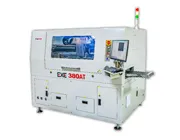
If your production requires fully automated inline loading and unloading, consider an inline PCB depaneling machine such as the EXE 880AT.
The EXE 880 is suitable for manufacturers that require flexible, standalone PCB depaneling without direct integration into an SMT line. Its dual-worktable design makes it particularly suitable for high-mix production, frequent product changeovers, irregular PCB shapes, and small-to-medium production batches.
For factories that require continuous automatic loading, unloading, and inline production, an inline PCB depaneling system may be more appropriate.
The EXE 880 Offline PCB Depaneling Machine is suitable for a wide range of PCB and PCBA production environments where cutting accuracy, low mechanical stress, flexible routing, and stable process control are important.
Automotive Electronics: Suitable for ECU, ADAS, control modules, and other automotive PCB assemblies that require stable routing, accurate positioning, and consistent cutting quality.
Medical Electronics: Suitable for PCB assemblies used in monitoring, diagnostic, and other medical electronic equipment where controlled routing, low separation stress, and process repeatability are important. Learn more about our PCB depaneling solutions for medical electronics.
Communication and 5G Electronics: Suitable for communication modules, RF boards, network equipment, and 5G electronics that may use high-density layouts and require precise PCB separation.
Industrial Control Electronics: Suitable for PLCs, control boards, automation equipment, and industrial electronic assemblies that require flexible PCB routing and reliable production changeovers.
Consumer and Smart Electronics: Suitable for compact consumer electronics, smart devices, and connected products with irregular PCB shapes, dense component layouts, or frequent product changes.
Is the EXE 880 an offline PCB depaneling machine? |
Yes. The EXE 880 is a standalone offline PCB depaneling machine designed for high-precision PCB and PCBA routing. Its dual-worktable structure supports flexible loading and unloading, making it suitable for high-mix production and frequent product changeovers. |
What PCB thickness can the EXE 880 process? |
The EXE 880 supports PCB cutting thicknesses from 0.3 mm to 6.0 mm. The actual routing process should also consider PCB material, router-bit diameter, cutting depth, and production requirements. |
What is the cutting accuracy of the EXE 880? |
The EXE 880 has a specified cutting accuracy of ±0.05 mm, X-Y repeat accuracy of ±0.02 mm, and CCD calibration accuracy of ±0.01 mm. These capabilities help support stable and repeatable PCB routing. |
Does the EXE 880 use CCD vision alignment? |
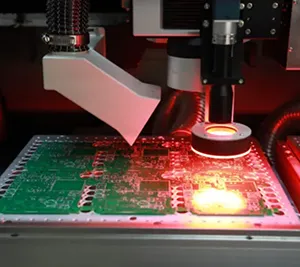
Yes. The EXE 880 uses a CCD vision positioning system to identify PCB reference points and compensate for positional variation before cutting. This helps improve routing-path accuracy, especially for densely populated or irregular PCB assemblies. |
Does the EXE 880 support dust extraction? |
Yes. The EXE 880 uses a sealed lower dust-extraction system to remove PCB routing debris close to the cutting area. An optional upper dust-collection mechanism is also available for applications requiring enhanced local dust extraction. |
How does the EXE 880 monitor router-bit condition? |
The machine uses photoelectric sensors to monitor the milling cutter during operation. Cutter-status monitoring helps detect tool breakage and reduce the risk of continued production with a damaged router bit. The software also supports segmented cutter usage and automatic down-cutting compensation. |
Who should choose the EXE 880 instead of an inline PCB depaneling machine? |
The EXE 880 is a good choice for manufacturers that need flexible standalone production, frequent product changeovers, multiple PCB models, or small-to-medium production batches. For continuous high-volume production requiring automatic loading and unloading or direct SMT-line integration, an inline PCB depaneling system may be more suitable. |
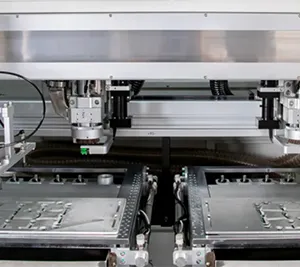
The fully automatic PCB board separator uses a high-speed NSK spindle for cutting, significantly reducing cutting stress. It features high precision, low inertia, and fast response.
The PCB loading and unloading area on the dual Y-axis workbenches is equipped with a grating safety system to prevent manual errors and meet public safety requirements.
The user interface offers a friendly switch between Chinese and English, with a graphical interface that makes program editing simple and allows for the quick creation of multi-point programs.
The software provides multiple levels of user management permissions to prevent accidental operations.
The dust collection system under the fully automatic PCB board separator is designed to be sealed, with the suction inlet at a 45-degree angle to reduce the formation of vortices inside that could generate dust.
The upper dust collection mechanism (optional) uses electrostatic brushes to seal the cutting point, providing independent dust collection for each cutting point and significantly enhancing the dust removal effect.
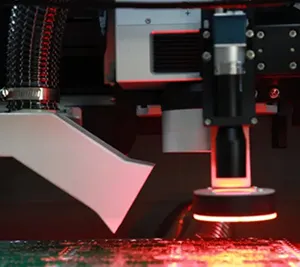
The milling cutter detection system uses photoelectric sensors to monitor the milling cutter’s status in real time, effectively preventing the machine from continuing to operate after the cutter breaks.
The software allows for the setting of milling cutter segmentation functions and automatic down-cutting compensation, which extends the milling cutter’s service life and reduces costs.