𐄀 Focus on providing PCBA separator manufacturing process solution

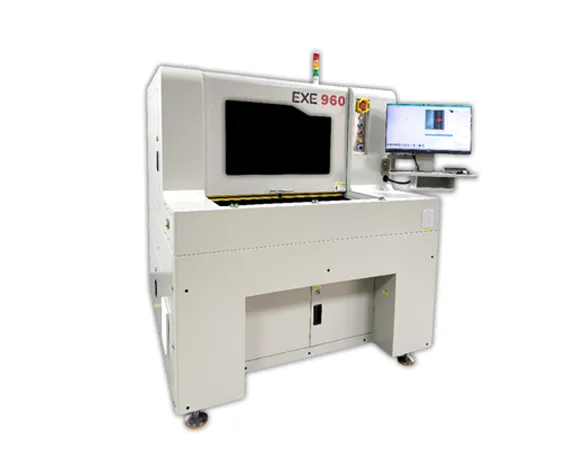
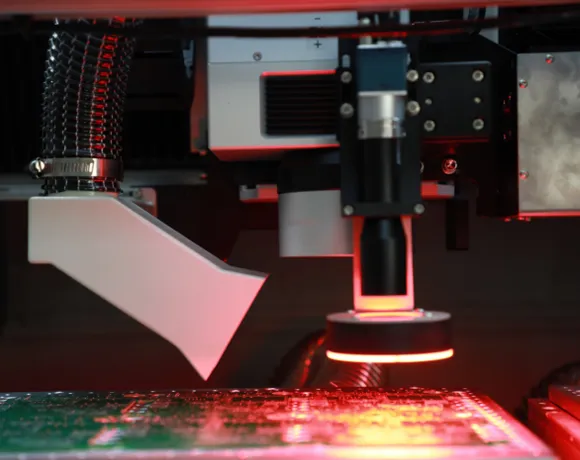
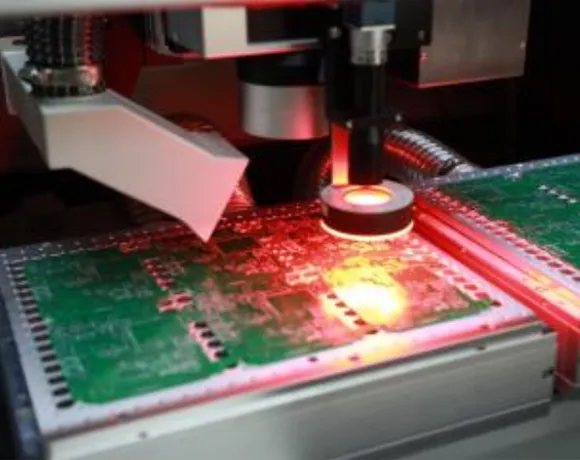
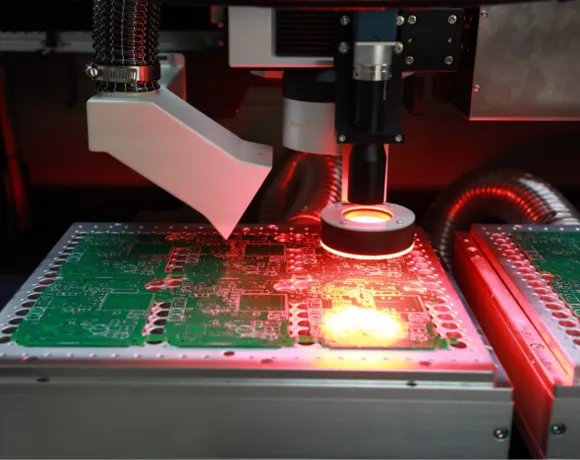
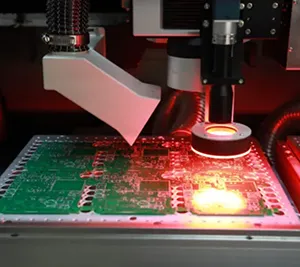
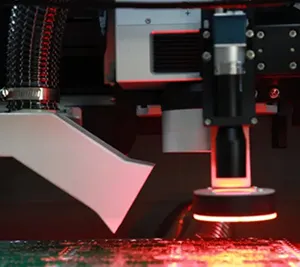
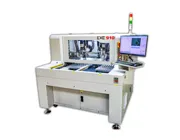
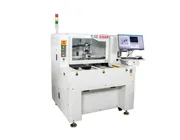
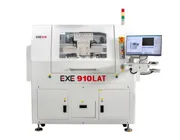
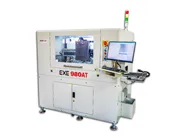
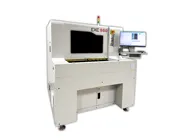
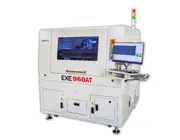
The EXE 960 is an offline laser PCB depaneling machine designed for precise, non-contact separation of PCB and PCBA panels. It combines laser processing, CCD vision positioning, CNC motion control, and dual Y-axis worktables to support accurate cutting of straight lines, arcs, irregular contours, and other programmed PCB profiles.
With cutting precision up to ±20 μm, repeatability of ±2 μm, and X/Y/Z resolution of 1 μm, the EXE 960 is suitable for electronics manufacturers that require high-precision PCB separation with very low mechanical cutting force.
The following specifications summarize the core performance, motion control, vision positioning, cutting functions, and equipment requirements of the EXE 960. Actual configuration may vary according to selected options and application requirements.
| Parameter | Specification |
|---|---|
| Core Performance | |
| Cutting Precision | ±20 μm |
| Repeatability | ±2 μm |
| Maximum Moving Speed | X/Y Axis: 1,000 mm/s; Z Axis: 800 mm/s |
| Mirror Speed | ≥8,000 mm/s |
| PCB Size | 300 × 350 (Customizable) |
| Machinable Material Thickness | ≤2 mm |
| Laser Power | 20 W (Optional) |
| X/Y/Z Resolution | 1 μm |
| Motion, Vision & Control | |
| XYZ Control Mode | CNC Motion Controller |
| Platform Structure | Marble Platform |
| CCD Light Source | Circular Light + Coaxial Light |
| Positioning Method | CCD + MarkThermal |
| Compensation Method | Linear Compensation + Single-PCS |
| Cooling Method | Water-Cooled |
| XYZ Drive Method | AC Servo |
| Mark Point Types | Standard Shape, Circular, Square |
| Cutting Functions | |
| Supported Cutting Functions | Straight Line, Semi-Circular Arc, Circular Arc, Left/Right Copy, Rotational Copy, Matrix Copy, Automatic Correction Compensation |
| Utilities & Machine Data | |
| Equipment Power | AC 220 V ±10%, 50/60 Hz, 1.5 kW |
| Air Supply | 4–6 kg/cm² |
| Operating Temperature | -20°C to ±45°C |
| Operating Humidity | 30%–60% |
| Machine Dimensions | 1,400 × 1,500 × 1,600 mm |
| Machine Weight | 900 kg |
Stable Marble Platform: The precision marble platform provides a stable mechanical reference for laser processing, motion control, and repeated PCB positioning.
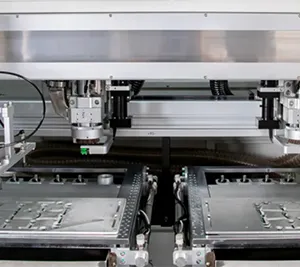
Dual Worktable Design: Two work areas can accommodate separate fixtures and product setups, supporting flexible loading and production changeovers in an offline environment.
Servo-Driven Dual Y Axes: Independent Y-axis worktables use servo-driven motion to support stable positioning and efficient PCB loading and processing.
Dedicated CNC Motion Control: An independent CNC motion controller coordinates the machine axes and programmed cutting paths for repeatable laser processing.
CCD Vision Positioning: Vision-based Mark recognition helps identify PCB position and supports coordinate correction before laser cutting.
Flexible Cutting Paths: The system supports straight lines, arcs, circular paths, copying functions, and automatic correction for different programmed PCB profiles.
Bilingual User Interface: Chinese and English interface options support machine setup and daily operation for different production teams.
Safety Light-Curtain Protection: The PCB loading and unloading areas use safety light curtains to help reduce the risk of unintended operation during manual handling.
Laser and router depaneling solve different PCB manufacturing requirements. Laser processing can be especially useful when mechanical cutting force, precision, narrow paths, or complex contours are major considerations.
Non-Contact PCB Separation
Laser processing removes material without a rotating milling cutter contacting the PCB. This significantly reduces mechanical cutting force transferred into the board compared with mechanical separation.
High-Precision Cutting
The EXE 960 specifies ±20 μm cutting precision and ±2 μm repeatability, supporting applications where dimensional consistency is an important process requirement.
Flexible Cutting Geometry
Programmed laser paths can support straight lines, arcs, circular profiles, and irregular contours without relying on a physical router-bit diameter to define every cutting radius.
No Router-Bit Wear
Because laser depaneling does not use a mechanical milling cutter, there is no router-bit replacement or cutting-edge wear to manage during the separation process.
Important: Laser depaneling is not automatically the best choice for every PCB. Material, thickness, cutting path, thermal characteristics, required cycle time, extraction requirements, and production cost should all be evaluated before selecting the process.
The EXE 960 is suitable for manufacturers evaluating offline laser PCB depaneling where precision, complex cutting paths, low mechanical cutting force, and flexible product changeovers are important. It is particularly relevant when the production process does not require direct integration with an SMT or automated handling line.
Machine selection should consider PCB material, material thickness, panel dimensions, cutting geometry, component clearance, required cutting quality, expected cycle time, production volume, and extraction requirements.
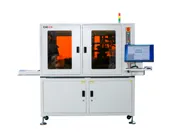
For high-volume production requiring automatic board feeding, cutting, and output, manufacturers can also evaluate the EXE 960AT Online Laser Depaneling Machine.
The EXE 960 is designed for laser depaneling, while mechanical PCB routers provide a different balance of board thickness capability, process cost, cutting speed, and material compatibility. The correct technology should be selected according to the actual PCB.
| Factor | EXE 960 Laser Depaneling | Router Depaneling |
|---|---|---|
| Cutting Method | Non-contact laser processing | Mechanical milling |
| Mechanical Cutting Force | Very low | Low when fixture and routing parameters are optimized |
| Cutting Tool Wear | No mechanical router bit | Router bit is a consumable tool |
| Complex Contours | Excellent flexibility | Excellent where router-bit access is available |
| Typical Selection | Precision and mechanically sensitive applications | Broad rigid-PCB routing applications |
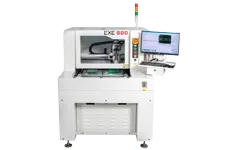
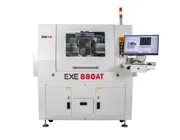
For conventional rigid PCB routing or broader mechanical depaneling requirements, see the EXE 880 Offline PCB Depaneling Machine.
| Production Factor | EXE 960 Offline | EXE 960AT Online |
|---|---|---|
| Machine Type | Standalone offline workstation | Automated inline laser system |
| PCB Handling | Operator-assisted loading and unloading | Automatic board feeding, cutting, and output |
| Typical Production | Flexible offline or high-mix production | Automated high-volume production |
| Line Integration | Not required | Designed for automated production-line integration |
The EXE 960 can be evaluated for electronic PCB assemblies where cutting precision, low mechanical force, complex cutting geometry, or non-contact processing are important. Suitability should be confirmed according to the actual PCB material and production requirements.
Medical Electronics
Precision control boards, monitoring electronics, diagnostic equipment, and other medical PCB assemblies can require controlled separation where mechanical cutting force and component clearance are important. Learn more about PCB depaneling for medical electronics.
Communication & RF Electronics
Communication modules, RF electronics, optical communication equipment, and high-density network electronics may require precise cutting paths and controlled PCB separation. See PCB depaneling for communication and 5G electronics .
Smart Wearable Electronics
Compact wearable electronics may use small PCB layouts, narrow separation paths, and components located close to the board edge. Explore PCB depaneling for smart wearable electronics.
Compact Consumer Electronics
Small electronic devices with dense layouts, irregular contours, or limited cutting clearance can be evaluated for precision laser depaneling.
Precision Electronic Assemblies
PCB assemblies requiring repeatable cutting dimensions, complex programmed contours, or especially low mechanical cutting force may also be suitable candidates for laser depaneling.
Not sure which depaneling technology is appropriate? Compare router, laser, V-cut, punching, and other separation processes in our PCB Depaneling Methods Comparison.
A laser PCB depaneling machine uses focused laser energy to remove material along a programmed separation path. Because no mechanical milling cutter contacts the PCB, the process introduces very little mechanical cutting force.
The EXE 960 specifies cutting precision of ±20 μm, repeatability of ±2 μm, and X/Y/Z resolution of 1 μm.
Laser depaneling is a non-contact process, so it does not apply the mechanical cutting force created by a router bit, saw, or mechanical separator. However, the complete laser process and PCB material should still be validated for the specific application.
The published EXE 960 specification lists a machinable material thickness of ≤2 mm. Actual suitability depends on PCB material, laser configuration, cutting requirements, and the validated process.
The EXE 960 supports programmed straight lines, semi-circular arcs, circular arcs, copying functions, and automatic correction compensation, allowing it to process a range of programmed PCB profiles.
Laser depaneling is worth considering when non-contact processing, very low mechanical cutting force, high precision, or complex cutting paths are important. Router depaneling can be more suitable for many conventional rigid PCB applications and broader mechanical routing requirements. The final choice should be based on the actual PCB and production process.
Useful information includes PCB material, thickness, board and panel dimensions, cutting drawing, cutting-path geometry, component clearance, required cutting quality, expected production volume, and cycle-time requirement.
Evaluate the EXE 960 for Your PCB Application
Send EXE your PCB material, thickness, panel drawing, cutting path, component clearance, production volume, and expected cycle time. Our team can help evaluate whether the EXE 960 laser PCB depaneling machine is suitable for your production requirements.
Request a PCB Depaneling Evaluation