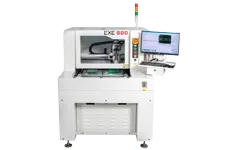
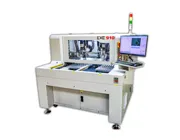
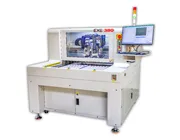
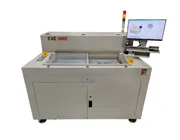
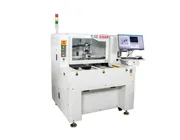
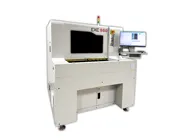
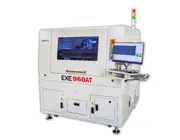
𐄀 Focus on providing PCBA separator manufacturing process solution


1. Miniaturization + High Integration + On-Board Antennas
WiFi modules typically measure 10mm×10mm to 30mm×30mm, featuring densely packed on-board ceramic antennas, chip antennas, and RF connectors, making separation difficult:
Cutting damage to antennas/circuitry
Impact damage to micro-components
Module deformation causing antenna performance drift
2. RF performance is extremely sensitive to depaneling quality. In 2.4GHz/5GHz/6GHz bands, burrs, stress, or micro-cracks at cut edges directly impact:
Transmission power (EVM) ◦ Reception sensitivity
Spurious and adjacent channel interference A single depaneling defect can cause an entire batch to fail RF specifications.
3. FPC / Rigid-Flex Boards + Microvia / Bridge Connections Multi-module designs commonly use microvia separation, micro-bridge connections, and FPC flexible boards. Traditional punching/manual separation often causes:
Bridge residue, burrs
FPC tearing, deformation
Edge chipping affecting SMT/assembly
4. Dual-scenario consumer + industrial applications face high yield and cost pressures. Consumer WiFi modules ship in tens of millions, demanding high-speed mass production + high yield rates; industrial/automotive WiFi requires extreme temperature and vibration reliability, where de-panel stress is a primary failure factor.
5. Compact shielding/structural assembly: Most modules feature metal shielding covers. Board separation dimensional deviations cause shielding assembly defects, poor heat dissipation, and EMC leakage.
Home/enterprise wireless routers, AC/AP mainboards and daughterboards
WiFi 6/6E/7 standalone modules, WiFi+BT combo modules
Industrial WiFi modules, automotive WiFi / automotive-grade WiFi modules
Smart home / IoT device WiFi modules (cameras, speakers, gateways) • WiFi functional boards for consumer electronics like set-top boxes, TVs, projectors
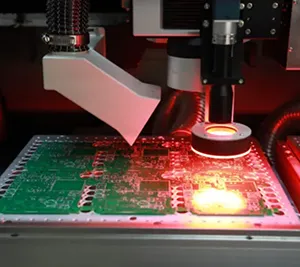
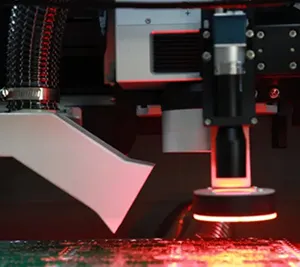
Ultra-precision vision positioning and micro-board adaptation vision systems support automatic recognition and correction for tiny PCBs, pinhole-sized apertures, and irregularly shaped boards. Positioning accuracy ≤±0.01mm prevents misalignment cuts and damage to antennas/circuitry.
Low-stress/non-contact routing prioritizes laser routing or precision milling cutters to minimize mechanical stress, prevent module deformation, component displacement, and solder joint fatigue, ensuring stable RF performance.
Dedicated routing strategies for microvias/microbridges support microvia milling and microbridge precision cutting with burr-free, residue-free, and chipping-free edges for seamless downstream assembly and soldering.
FPC/rigid-flex compatible: Optimized for flexible and rigid-flex boards, ensuring no cracking, stretching, or delamination during separation to preserve module structural integrity.
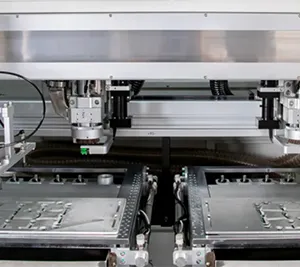
High-speed mass production & quick changeovers: Automated loading/unloading with multi-station/multi-panel processing achieves consumer electronics-level hourly output. Supports rapid program recall for mixed-model module production lines.
RF-Friendly Design: Optimized EMC performance eliminates strong electromagnetic interference. Post-depaneling leaves no metallic dust or conductive residues, preventing RF shorts and interference.
High Yield & Consistency: Target yield ≥99.9%. Consistent module dimensions and cut quality after batch depaneling ensure high SMT and final assembly pass rates.