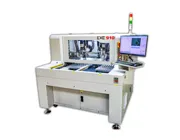
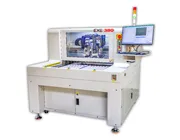
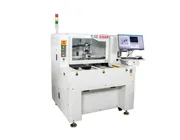
𐄀 Focus on providing PCBA separator manufacturing process solution

Quick Answer
The five common PCB depaneling methods are router cutting, laser cutting, V-cut or V-score separation, die punching, and saw or blade cutting. Each method offers a different balance of mechanical stress, cutting flexibility, edge quality, production speed, tooling requirements, and cost.
In general, router depaneling provides excellent flexibility for irregular PCB shapes, laser depaneling is useful when very low mechanical stress and high precision are priorities, V-cut works well for straight-edged panels, punching can be efficient for stable high-volume production, and saw cutting is suitable for certain straight-line separation applications.
PCB depaneling, also called PCB singulation or PCB separation, is the process of separating individual printed circuit boards from a larger production panel after fabrication or assembly. Although it is usually one of the final steps in PCBA manufacturing, the selected depaneling method can influence board stress, edge quality, production efficiency, fixture requirements, and the risk of damage to nearby components.
There is no single depaneling technology that is best for every PCB. A rectangular power board produced in very high volumes may require a completely different process from a thin, densely populated medical PCB or an irregular automotive control board.
A peer-reviewed review of PCB panel depanelization methods also discusses the relationship between PCB panel design, V-scoring, tab routing, and the final separation process. This highlights an important principle: depaneling should be considered during PCB and panel design, not only after the assembly process is complete.
The table below provides a quick comparison of the five methods. Actual performance depends on PCB material, thickness, equipment configuration, tooling, fixture design, and process parameters.
| Method | Mechanical Stress | Shape Flexibility | Tool Wear | Typical Strength | Main Limitation |
|---|---|---|---|---|---|
| Router | Low when properly controlled | Excellent | Yes | Flexible contours and high-mix production | Generates routing dust |
| Laser | Very low | Excellent | No mechanical cutting tool | Precision and non-contact processing | Material and thermal-process considerations |
| V-Cut / V-Score | Moderate during separation | Low | Low | Fast straight-line separation | Straight-line geometry only |
| Punching | Relatively high | Limited by tooling | Die wear | Very fast repeated production | Dedicated tooling required |
| Saw / Blade Cutting | Moderate | Mainly straight cuts | Yes | Efficient linear separation | Limited contour flexibility |
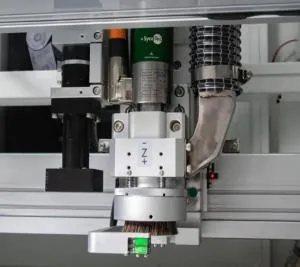
Router depaneling uses a high-speed spindle and milling cutter to remove material along a programmed PCB outline or tab-routing path. Because the cutter can follow X-Y toolpaths, routing is highly flexible and can process rectangular, curved, irregular, or complex board outlines.
Modern router systems may combine servo motion control, CCD vision alignment, cutter monitoring, fixtures, and dust extraction. When the PCB is properly supported and the cutting parameters are optimized, routing can provide precise separation with relatively low mechanical stress.
Router Depaneling Is Often a Good Choice When:
PCB outlines are irregular or curved.
Manufacturers process multiple PCB models.
Frequent product changeovers are required.
Cutting-path flexibility is important.
Controlled, repeatable mechanical separation is required.
The main trade-offs are router-bit wear and dust generation. Router bits must be monitored because wear can affect edge quality and cutting force, while FR4, resin, and fiberglass particles require effective extraction.
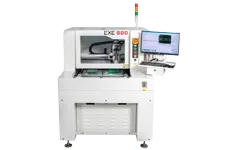
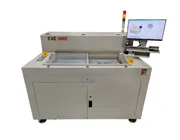
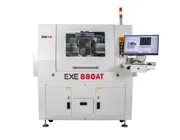
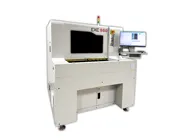
For a practical router-based system, see the EXE 880 Offline PCB Depaneling Machine. For a deeper explanation of spindle performance, CCD positioning, router-bit condition, and cutting quality, read How Does a PCB Depaneling Machine Achieve Clean and Precise Cuts?
Laser depaneling removes PCB material using focused laser energy instead of a mechanical cutter. Because there is no physical cutting tool contacting the PCB, the process introduces very little mechanical force into the board or nearby components.
This makes laser processing particularly attractive for thin boards, densely populated assemblies, narrow cutting paths, sensitive components, and applications where mechanical stress is a major concern.
An IPC technical paper on laser PCB depaneling discusses the advantages of non-contact processing, including reduced mechanical stress and the ability to follow precise cutting paths. However, laser processing also requires consideration of PCB material, laser wavelength, process speed, thermal effects, fumes, and cut-wall quality.
Laser Depaneling Is Often Considered When:
Very low mechanical stress is required.
Components are positioned close to the cutting path.
The PCB is thin or mechanically sensitive.
Narrow kerf or complex contours are required.
Mechanical cutting-tool wear should be avoided.
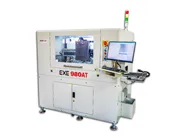
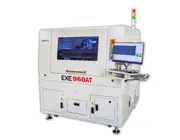
The EXE 960 Offline Laser Depaneling Machine is an example of a non-contact laser solution designed for precision PCB separation.
V-scoring creates V-shaped grooves along the top and bottom surfaces of a PCB panel while leaving a thin section of material connecting the individual boards. The boards are later separated along the scored line manually or with a dedicated V-cut separator.
One of the biggest advantages of V-scoring is production efficiency. Boards can be placed close together because a router channel between adjacent PCBs is not always required. However, the scoring path must normally continue in a straight line, which significantly limits board geometry.
Altium's guide to mouse bites and V-scores highlights design considerations such as copper and component clearance around score lines. Eurocircuits similarly notes that V-cut separation is generally limited to rectangular PCB outlines.
Main Limitation: V-score depaneling is not suitable for every PCB outline. Curves, internal contours, and irregular shapes usually require routing, laser processing, or another separation method.
Punching uses a dedicated punch-and-die tool to mechanically separate a PCB from the panel. Instead of following the board outline gradually, the tooling applies force to separate the PCB in a short production cycle.
The major advantage is throughput. Once the tooling and process are established, punching can support highly repetitive production. However, dedicated tooling increases the initial investment and reduces flexibility when board dimensions or outlines change.
Punching Is Most Appropriate When:
The PCB design is stable and unlikely to change frequently.
Production volume is high enough to justify dedicated tooling.
Very short separation cycle time is important.
The PCB and component layout can tolerate the mechanical separation process.
Punching is usually less attractive for high-mix environments because a design change may require new tooling. Mechanical shock and board support must also be considered for assemblies containing sensitive components.
Saw depaneling uses a rotating blade or linear cutting system to separate PCBs along defined lines. Like V-cut separation, it is most practical when the required cuts are relatively straight and the PCB design does not require complex contour following.
Sawing can provide efficient linear cutting and may be useful for certain rigid PCB structures or panel formats. However, because it is a mechanical process, blade condition, fixture stability, cutting speed, vibration, and debris control still affect the final result.
Compared with CNC routing, saw cutting provides less freedom for irregular contours. Manufacturers that frequently process different board shapes will generally benefit more from programmable router or laser systems.
The best PCB depaneling method should be selected from the complete manufacturing requirement rather than from equipment speed alone. The following factors usually have the greatest influence.
Straight rectangular boards can support V-score, saw, router, laser, or in some cases punching. Irregular contours, curved edges, and complex board shapes usually require programmable router or laser cutting.
Assemblies with BGAs, ceramic components, connectors, sensors, or other sensitive devices close to the separation path require careful control of board movement and mechanical stress. Laser processing may offer an advantage for especially stress-sensitive layouts, while properly fixtured router depaneling can support many conventional rigid PCB assemblies.
FR4, metal-core boards, ceramic substrates, flex materials, rigid-flex structures, and high-frequency laminates can respond differently to mechanical or laser processing. Material compatibility should therefore be verified before the cutting process is finalized.
High-mix factories generally value programmable processes and fast product changeovers, making router or laser systems attractive. Dedicated punching tools may become more economical when production volume is high and the PCB design remains stable. V-score systems can also provide excellent throughput for compatible rectangular panels.
Mechanical routing and sawing generate cutting debris and require appropriate extraction. Laser cutting eliminates router-bit dust but can generate fumes and ablation particles, which also require suitable extraction and process control.
Manufacturers should also decide whether the process will operate as a standalone offline workstation or as part of an automated inline production line. Loading, unloading, barcode recognition, MES connectivity, traceability, and cycle-time requirements may influence the final equipment configuration.
| Production Requirement | Method to Consider | Reason |
|---|---|---|
| Irregular or curved PCB shapes | Router / Laser | Programmable cutting paths provide greater contour flexibility. |
| Very low mechanical stress | Laser | Non-contact cutting minimizes mechanical force on the PCB. |
| High-mix, frequent changeovers | Router / Laser | Programs can be changed without dedicated punch tooling. |
| Rectangular boards with straight separation lines | V-Cut / Saw | Straight-line separation can provide high production efficiency. |
| Very high-volume, stable PCB design | Punching | Dedicated tooling can support short repeated separation cycles. |
| Flexible routing with conventional rigid PCB | Router | Good balance of flexibility, precision, automation, and production cost. |
Depaneling equipment cannot completely compensate for a panel design that was created without considering the final separation process. V-score locations, breakaway tabs, mouse bites, router channels, component keep-out areas, fiducial marks, tooling holes, and panel rigidity can all influence depaneling performance.
This is particularly important when moving from manual separation to automated depaneling. The panel should provide sufficient support for the PCB while still allowing the cutting tool, laser path, fixture, and vision system to access the required areas.
DFM Tip: Select the intended depaneling process before finalizing the production panel whenever possible. Changing from V-score to router or laser after the PCB and panel layout are fixed may require changes to spacing, tabs, tooling features, or component clearance.
Common PCB depaneling methods include CNC router cutting, laser cutting, V-cut or V-score separation, die punching, and saw or blade cutting. Manual breakaway tabs may also be used in some low-volume applications.
Laser depaneling generally introduces the lowest mechanical stress because it is a non-contact cutting process. Router depaneling can also provide low-stress separation when PCB support, tool condition, cutting parameters, and routing sequence are properly controlled.
Generally no. V-score lines normally need to extend in a straight line across the panel, so the method is most suitable for rectangular or straight-edged PCB layouts. Router or laser cutting provides much greater flexibility for curved or irregular shapes.
Router depaneling is often suitable for rigid PCBs, irregular board outlines, high-mix production, frequent product changes, and applications requiring programmable cutting paths. Appropriate dust extraction and router-bit management are important for stable operation.
No. Laser offers non-contact processing and very low mechanical stress, but router depaneling can be more practical for many rigid PCB applications. The correct choice depends on board material, thickness, cutting path, component sensitivity, production volume, cycle time, and total process cost.
Useful information includes PCB material, thickness, board and panel dimensions, cutting-path geometry, component clearance, acceptable mechanical stress, production volume, cycle-time target, cleanliness requirements, and whether the process must operate offline or inline.
Choosing the right PCB depaneling method requires balancing PCB geometry, material, component sensitivity, edge-quality requirements, production volume, automation level, and manufacturing cost.
Router depaneling offers strong flexibility for irregular PCB shapes and high-mix production. Laser depaneling provides non-contact separation for applications where very low mechanical stress or high precision is important. V-score and saw cutting are efficient for compatible straight-line designs, while punching can provide excellent throughput when production volumes justify dedicated tooling.
The best approach is to evaluate the depaneling process together with PCB panel design rather than treating separation as an isolated final step.
Not Sure Which PCB Depaneling Method to Choose?
Send EXE your PCB material, thickness, panel drawing, component clearance, production volume, and cycle-time requirement. Our team can help evaluate whether router, laser, or another depaneling approach is more suitable for your application.
Request a Depaneling Evaluation